Хазрат Масуме (с)
Шаблон:شروع متن Шаблон:سوال В чем причина высокого положения Хазрат Масуме (с) среди потомков имамов? Шаблон:پایان سوال Шаблон:پاسخ

Хазрат Масуме (с) (173-201 гг. хиджры) — дочь Имама Казима (с), сестра Имама Резы (с) и одна из добродетельных и известных женщин среди шиитов.
Её настоящее имя Фатима, а среди её известных титулов — Масуме, Кариме Ахль аль-Байт, Шафи'а и Тахира. В хадисах ей приписываются статус заступничества, непорочности и научного положения. Имам Реза (с) приравнял награду за посещение могилы своей сестры к награде за посещение своей собственной могилы. Многие шиитские учёные передали много сведений о благородстве и достоинстве Фатимы Масуме (с).
Одним из важнейших событий в жизни Фатимы Масуме (с) было её путешествие в Иран, чтобы встретиться со своим братом Имамом Резой (с). В шиитских книгах говорится, что во время этого путешествия в городе Саве на их караван было совершено нападение, и некоторые члены её каравана были убиты. Фатима Масуме (с) заболела после этого инцидента и скончалась в Куме после прибытия туда.
Место захоронения Фатимы Масуме (с) находится в городе Кум. Изначально её могила была простой. Этот мавзолей развивался в различные периоды правления, особенно во времена шиитских правителей. Пик развития мавзолея Фатимы Масуме (с) пришёлся на период Сефевидов и после них. Шаблон:Портал
Положение
Фатима Масуме (с) считается одной из самых добродетельных потомков имамов среди шиитов.[1] Она дочь Имама Мусы Казима (с), сестра Имама Резы (с) и тётя Имама Джавада (с). Её мавзолей в Куме считается вторым святилищем Ахль аль-Байт (с) в Иране после мавзолея Имама Резы (с) в Мешхеде.[2]
Достоинство
Фатима Масуме (с) считается обладательницей статуса заступничества.[3] Имам Джафар Садик (с) считал заступничество Фатимы Масуме (с) причиной вхождения шиитов в рай.[4] Некоторые, опираясь на это предание, считают заступничество Фатимы Масуме (с) обширным.[5]
Некоторые, опираясь на часть зиярат-наме Фатимы Масуме (с), считают её дочерью духа и тела Пророка Мухаммада (с), Хазрат Захры (с), Хадиджи Кубры (с) и непорочных имамов (с).[6] Также из другой части этого зиярат-наме доказывается статус непорочности для Фатимы Масуме (с).[7]
Благословения и достоинства, связанные с её прахом и посещением её, являются другими аспектами достоинства Фатимы Масуме (с). В некоторых преданиях награда за посещение Фатимы Масуме (с) считается раем.[8] Многие шиитские учёные передали много сведений о благородстве и достоинстве Хазрат Фатимы Масуме (с)[9]. Например, сообщается, что Мулла Садра, шиитский философ, умерший в 1050 г. хиджры, для решения своих научных и философских проблем посещал её и обращался к ней за помощью.[10] Также Шейх Аббас Куми (1294-1359 гг. хиджры), шиитский хадисовед и историк, назвал Фатиму Масуме (с) Сайидой Джалилой и самой добродетельной из дочерей Имама Мусы Казима (с).[11] Многие чудеса, связанные с посещением и её мавзолеем, упоминаются в источниках.[12]

Знания
Фатима Масуме (с) считается одной из учёных женщин и передатчиц хадисов.[13] Шиитские и суннитские хадисоведы приводили хадисы, переданные Фатимой Масуме, в своих источниках. Среди этих хадисов можно отметить следующие:
1. Мухаммад ибн Мухаммад Джазари (751-833 гг. хиджры), шафиитский хадисовед и факих, передаёт через Фатиму Масуме (с), а она через дочерей непорочных имамов (с), таких как Сакина, дочь Имама Хусейна (с), и Умм Кульсум, дочь Имама Али (с), от Фатимы Захры (с), что она сказала: Шаблон:متن عربی[14]
2. Бакр ибн Ахмад передаёт от Фатимы, дочери Имама Резы (с), а она от Фатимы Масуме (с), а она через дочерей непорочных имамов (с) от Фатимы Захры (с), что Посланник Аллаха (с) говорил, что в Судный день все будут призваны по именам своих матерей, кроме шиитов Али ибн Аби Талиба (с).[15]
Титулы
Шаблон:Также см. Многие титулы для Хазрат Масуме (с) упоминаются в источниках: среди них Тахира (чистая), Хамида (восхваляемая), Бирра (благочестивая), Рашида (зрелая), Такыйя (богобоязненная), Разийя (довольная Аллахом), Марзийя (угодная Аллаху), Накийя (чистая), Ухт ар-Рида (сестра Имама Резы), Сайида Саддика (очень правдивая госпожа), Сайида Разийя Марзийя (госпожа, довольная Аллахом и угодная Ему), Мухаддиса (передатчица хадисов), Абида (поклоняющаяся) и Ситти (госпожа).[16]
Масуме — один из других известных титулов дочери Имама Казима (с). Этот титул взят из предания, переданного от Имама Резы (с):Шаблон:متن عربی Хотя титул Масуме не указывает на непорочность в степени непорочности непорочных имамов (с), он выражает её обладание более низкой степенью в положении непорочности; степенью, которая не встречается у обычных людей.[17]
Среди других титулов Хазрат Масуме (с) — Кариме Ахль аль-Байт. Мараши Наджафи (1276-1369 гг. хиджры), шиитский марджа' таклид, сказал, что Имам Мухаммад Бакир (с) или Имам Джафар Садик (с) во сне сказал его отцу: «Тебе надлежит Кариме Ахль аль-Байт».[18] Шафи'а — ещё один титул Фатимы Масуме (с). От Имама Садика (с) передаётся: Шаблон:متن عربی[19]
Biography

Not much information is available about the life of Lady Ma'sumah (s); including her birth and death dates and details of her life.[20] According to some later sources, her birth occurred in the year 173 AH, during the caliphate of Harun al-Rashid, in Medina. Fatimah Ma'sumah lost her father, Imam Kazim (a), at the age of ten.[21] Fatimah Ma'sumah's (s) father was Imam Musa al-Kazim (a), the seventh Imam of the Shi'ites, and her mother, Najmah, was a virtuous lady. Shaykh Saduq narrated that Najmah Khatun was famous for her intelligence, wisdom, obedience, worship, and observance of etiquette. Historical sources have explicitly stated that Imam Reza (a) and Lady Ma'sumah (a) shared the same mother.[22]
Lady Ma'sumah (s) never married during her lifetime. Some have cited the reason for her not marrying as not finding a suitable match or someone worthy of her.[23] One of the mentioned possibilities regarding her non-marriage is that Imam Kazim (a) himself advised his daughters not to marry. Opponents of this claim have rejected such a will as being contrary to the tradition of the Prophet (s) and the practice of the Ahl al-Bayt (a). Some have also said that the severe repression during the time of Harun and Ma'mun al-Abbasi caused no one to dare easily visit the house of Musa ibn Ja'far and become his son-in-law. Furthermore, the imprisonment of Lady Musa ibn Ja'far (a), his martyrdom in prison, the summoning of Imam Reza (a) to Khorasan, and the Imam's separation from his sisters added to this reason.[24]
Journey to Iran and Demise
The author of the History of Qom states that in the year 200 AH, Ma'mun, the Abbasid Caliph, summoned Imam Reza (a) from Medina to Marv to be his successor. The Imam's sister, Fatimah Ma'sumah (s), set out for Iran in 201 AH with the intention of visiting her brother. It is said that Lady Fatimah Ma'sumah (s) had prepared herself for the journey after receiving her brother's letter.[25]
Fatimah Ma'sumah (s) traveled towards Tus in Iran in 201 AH. On this journey, five of Fatimah Ma'sumah's (s) brothers, namely Fadl, Ja'far, Hadi, Qasim, and Zayd, along with several of her nephews and some servants, accompanied her. According to some, Fatimah Ma'sumah (s) traveled with 23 of her brothers and nephews. Others have said that Lady Ma'sumah (s) was accompanied by only one servant on this journey.[26] Fatimah Ma'sumah (a) endured the hardships of this long journey until she reached the city of Saveh. The people of that city, who at that time were enemies of the Ahl al-Bayt (a), attacked her caravan. A fierce battle ensued, and all of her brothers and nephews were martyred. The grief of the martyrdom of 23 relatives eventually led Fatimah Ma'sumah to her sickbed. The people and nobles of Qom, who were lovers of the Prophet's family (s), upon learning of this event, went to Saveh and, after meeting Fatimah Ma'sumah (s), took her to Qom at her request. Fatimah Ma'sumah stayed for seventeen days in the house of one of the elders of Qom, named Musa ibn Khazraj al-Ash'ari, while she was ill. Finally, Fatimah Ma'sumah (s) passed away on the tenth of Rabi' al-Thani in the year 201 AH in the city of Qom.[27]
The exact date of Fatimah Ma'sumah's (s) death is not mentioned in early sources; however, later sources have stated her death anniversary as the tenth of Rabi' al-Thani in the year 201 AH, at the age of 28. Some have also recorded the twelfth of Rabi' al-Thani. Some researchers believe that both dates are estimates.[28] According to another account, after that attack in Saveh, enemies poisoned Fatimah Ma'sumah's (s) food, and that poison caused her illness and ultimately her martyrdom after seventeen days.[29]
Some have said that given the military conflict with Fatimah Ma'sumah's (s) caravan, her martyrdom was probable, as her illness was influenced by this war. The report in the History of Qom, stating Fatimah Ma'sumah's (s) death due to illness, can be interpreted as reflecting the conservative stance of the dominant Ash'aris who tried to maintain their relationship with the Abbasid government. The author of the History of Qom was one of the Ash'aris.[30]
Pilgrimage Prayer and Reward of Pilgrimage
Шаблон:Main article The pilgrimage to Lady Masuma holds a special status in the words of the Ahl al-Bayt, and narrations have been issued regarding its importance. These narrations speak of the reward for her pilgrimage.[31]
- Sa'd ibn Sa'd asked Imam Reza (AS) about the pilgrimage to Fatima, daughter of Musa? The Imam said: Шаблон:Arabic text[32] [33]
- Imam Jawad (AS) said regarding the virtue of visiting his aunt's grave: Шаблон:Arabic text[34]
Pilgrimage Prayer
Allama Majlisi in his book Bihar al-Anwar and some other works has narrated a pilgrimage prayer for Lady Masuma.[35] which is recited today beside her shrine.
This pilgrimage prayer begins with divine invocations. First, near the grave and facing the Qibla, one should recite "Allahu Akbar" 34 times, "Subhanallah" 33 times, and "Alhamdulillah" 33 times, and then the text of the pilgrimage prayer is recited.[36]
Shrine
According to historical sources, Fatima Masuma (SA) was buried in the Bagh Babilan neighborhood of Qom.[37] Initially, a mat was placed over her grave.[38] After that, the shrine of Lady Masuma (SA) has undergone many changes and developments throughout history and has expanded in different periods.[39] The construction of the sanctuary of Fatima Masuma (SA) began in the mid-3rd century AH, and from the 4th to the 6th centuries, it had a dome and was decorated.[40] However, until the Safavid era, there was no magnificent zarih (cage-like structure over a grave) or iwan (vaulted hall) for the shrine.[41]
During the Safavid period, the shrine was expanded, including the construction of the Atiq Courtyard and the Golden Iwan.[42] The expansion of the shrine continued during the Qajar period. Fath-Ali Shah paved the shrine's floor with marble. According to an inscription in the shrine, the mirror work on the shrine's walls also began during Fath-Ali Shah's reign and was completed during Mohammad Shah's time.[42] During the reign of Naser al-Din Shah Qajar, the Atabaki Courtyard was also built.[43] After the Islamic Revolution of Iran, the shrine was further expanded, and sections such as the Imam Khomeini Shabestan (prayer hall) were added to the shrine.[44]
After the Islamic Revolution of Iran, the shrine was also expanded, and sections such as the Imam Khomeini Shabestan were added to the shrine.[44]
Courtyards and Porticos
The Holy Shrine of Lady Masuma (SA) has several courtyards:
- The Atiq Courtyard, which is called the Small Courtyard, the Old Courtyard, and today the Imam Hadi (AS) Courtyard. This courtyard is square-shaped and has three iwans. The Golden Iwan is located in this courtyard.[45]
- The Atabaki Courtyard, which is called the New Courtyard and today the Imam Reza (AS) Courtyard. This courtyard was built during the reign of Naser al-Din Shah Qajar by Mirza Ali Asghar Khan Atabak. The Mirror Portico, which was built in 1130 AH by the order of Ali Akbar Khan Atabak, is located in this courtyard.[46]
- The Saheb al-Zaman (AS) Courtyard, which covers an area of about 8000 square meters and has four entrances. This courtyard is located next to the Imam Khomeini Shabestan.[44]
- The Jawad al-A'imma (AS) Courtyard; this courtyard, which covers an area of more than 15000 square meters, was built over the Qomrud river. This courtyard, with four main entrances and two emergency entrances, was built in the late 2000s.[47]
- The Prophet Muhammad (PBUH) Courtyard; the construction of this courtyard began in the late 2000s.[48]
There are six porticos in the Holy Shrine of Lady Masuma (SA), most of which have smaller domes than the main dome of the shrine. Three porticos were built by the Safavids, two by the Qajars, and one belongs to the contemporary era.[49]
Zarih
The first zarih (cage-like structure over a grave) of the tomb of Lady Masuma (SA) was built by Shah Tahmasp I. Shah Tahmasp later installed another zarih made of white and transparent steel around the previous one. This zarih was replaced in 1000 AH by Shah Abbas I Safavi with another zarih. Fath-Ali Shah Qajar covered this zarih with silver plates in 1245 AH and placed it on a marble base. After renovations, its shape was finally changed and its height increased in 1348 SH.[50] In 2001, the zarih of Lady Masuma (SA) underwent a complete renovation.[51]
Dome
The first dome over the tomb of Lady Masuma was built by a woman named Zaynab,[52] whom some have identified as the daughter of Imam Jawad (AS).[53] "Amir Abul Fazl Iraqi", the ruler of Qom during the Seljuk period, built a new dome.[54] In 925 AH, Shah Begum Safavi demolished this dome and built another one, which remains today. This dome was decorated in 1518 AH by the order of Fath-Ali Shah with 12,000 golden bricks. The height of this dome from the roof of the shrine is 16 meters and from the ground level is 32 meters.[55] The dome was renovated during the Islamic Republic in the 2000s.[56]
Minarets
- There are two minarets in the Atabaki Courtyard, which are among the tallest structures of the shrine and are located above the Mirror Iwan.
- Two minarets are located on the other side of the Atabaki Courtyard, opposite the Mirror Iwan.
- Two minarets were built in the Golden Iwan in the Atiq Courtyard, covered with spiral knot tiles.[57]
Gallery
-
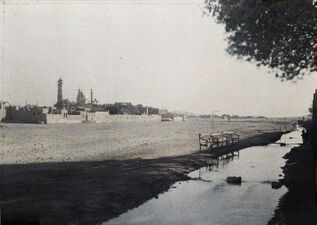
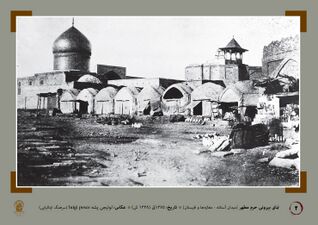 Exterior view of the Holy Shrine of Fatimah Ma'sumah (a.s.) from Astaneh Square (1238 SH).
 -
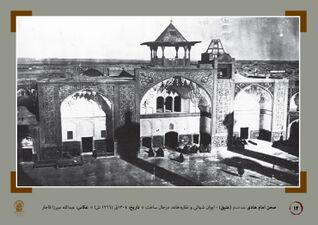 Atiq Courtyard and Naqqareh Khaneh (1266 SH).
 -
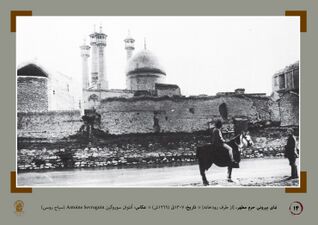 Exterior view of the Holy Shrine of Fatimah Ma'sumah (a.s.) from Qomrud and high walls built to prevent flood entry into the shrine (1269 SH).
 -
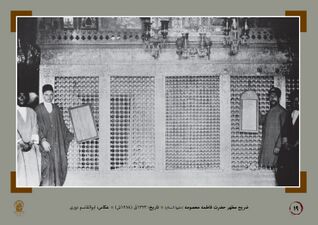 Zarih (sacred enclosure) of the tomb of Fatimah Ma'sumah (a.s.) (1284 SH).
 -
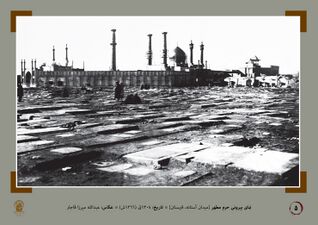
 Panoramic view of the Holy Shrine of Fatimah Ma'sumah (a.s.) (1306 SH).
 -
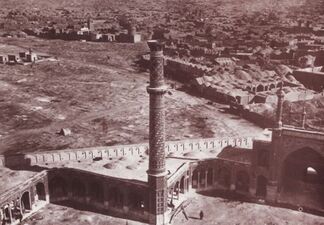 A view of a part of Atabaki Courtyard.
 -
 Exterior view of the Holy Shrine of Fatimah Ma'sumah from Astaneh Square (1266 SH).
 -
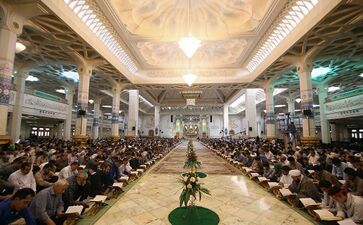 Collective Quran recitation in Imam Khomeini Shabestan of the Holy Shrine of Fatimah Ma'sumah (a.s.).
 -
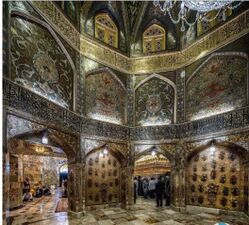 A view of one of the porticos of the Holy Shrine of Fatimah Ma'sumah (a.s.).
 -
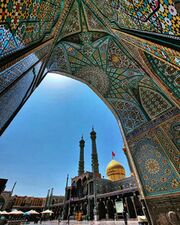 A view of the dome and minarets of Atabaki Courtyard of the Holy Shrine of Fatimah Ma'sumah (a.s.).


References
- ↑ Куми, Аббас ибн Мухаммад Реза, Мунтаха аль-Амаль фи Таварих ан-Наби ва аль-Аль, Кум, Дафтар Нашр Ислами, т. 2, с. 378.
- ↑ Исхаки, Сейед Хусейн, Махтаб Ахль аль-Байт (Путешествие по жизни Кариме Ахль аль-Байт Хазрат Масуме), Кум, Марказ Пажухешха-йе Ислами Сада ва Сима, 1386 г. хиджры, с. 3-6.
- ↑ Мухаммади Эштехарди, Мухаммад, Хазрат Масуме (с) Фатима-йе Довум, Кум, Нашр Ахлак, 1380, с. 178-179.
- ↑ Аль-Маджлиси, Бихар аль-Анвар аль-Джами'а ли Дурар аль-Ахбар аль-А'имма, Бейрут, Дар Ихья ат-Турас аль-Араби, 1403 г. хиджры, т. 57, с. 228.
- ↑ Мухаммади Эштехарди, Хазрат Масуме (с) Фатима-йе Довум, с. 178-179.
- ↑ Мухаммади Эштехарди, Мухаммад, «Хазрат Масуме (с), Ахтар Табан Ал-е Мухаммад (с)», Нашрийе Паздар Ислам, № 177, 1357.
- ↑ Мухаммади Эштехарди, Хазрат Масуме (с) Фатима-йе Довум, с. 159.
- ↑ Ибн Каулавайх, Джафар ибн Мухаммад, Камиль аз-Зиярат, исследование Абд аль-Хусейна Амини, Наджаф, Дар аль-Муртазавийя, с. 324.
- ↑ Для получения информации о некоторых примерах см.: Мухаммади Эштехарди, Мухаммад, «Хазрат Масуме (с), Ахтар Табан Ал-е Мухаммад (с)».
- ↑ Куми, Аббас ибн Мухаммад Реза, Аль-Фаваид ар-Разавийя фи Ахвал Улама аль-Мазхаб аль-Джафарийя, исследование Насира Багери Бидеханди, Кум, Бустан-е Китаб, 1385, с. 618.
- ↑ Куми, Мунтаха аль-Амаль, т. 2, с. 378; также: Куми, Аббас ибн Мухаммад Реза, Мафатих аль-Джинан, Кум, Интишарат Асва, б.г., с. 562.
- ↑ Для подробной информации см.: Мухаммади Эштехарди, Хазрат Масуме (с) Фатима-йе Довум, с. 191-219.
- ↑ Садеки Ардестани, Ахмад, Занан Данешманд ва Рави Хадис, Кум, Марказ Интишарат Дафтар Таблигат Ислами, 1377, с. 350-351.
- ↑ Ибн аль-Джазари, Мухаммад ибн Мухаммад, Асна аль-Маталиб фи Манакиб аль-Имам Али (с), Исфахан, Мактабат аль-Имам Амир аль-Муминин Али (с) аль-Амма, с. 50-51.
- ↑ Аль-Куми, Аббас ибн Мухаммад Реза, Сафинат аль-Бихар ва Мадинат аль-Хикам ва аль-Асар, Тегеран, Дар аль-Усра лит-Тиба'а ва ан-Нашр, 1392, т. 4, с. 545.
- ↑ На'ини Ардестани, Мухаммад Али ибн Хусейн, Анвар аль-Муша'ша'ин, исследование Мухаммада Резы Ансари Куми, Кум, Большая библиотека Хазрат Аятоллы аль-Узма Мараши Наджафи, т. 1, с. 211; также: Рафи'и, Али, Тарих Зиндагани Имам Казим (с), Тегеран, Сепах Пасдаран Инкилаб Ислами, Намайандеги Вели-йе Факих, Идаре Амузешха-йе Акидати Сияси, с. 21.
- ↑ Рафи'и, Тарих Зиндагани Имам Казим (с), с. 21.
- ↑ Рафи'и, Тарих Зиндагани Имам Казим (с), с. 21.
- ↑ Рафи'и, Тарих Зиндагани Имам Казим (с), с. 21.
- ↑ Mahallati, Riyāḥīn al-Sharīʿah, vol. 5, p. 31.
- ↑ From Birth to Death, Comprehensive Portal of the Holy Shrine of Lady Fatimah Ma'sumah (s), date of publication: 1398, date of visit: 1401.
- ↑ A group of writers, Encyclopedia of Imam Kazim (a), no place, Ashura Specialized Website, no date, p. 338.
- ↑ Ilhami, Davood, A Journey through the History of Shi'ism, Qom, Maktab Islam, 1375, p. 545.
- ↑ Hosseini, Seyyed Javad, "The Secret of Lady Ma'sumah's (s) Non-Marriage," Farhang Kowsar, 1386, no. 69.
- ↑ Faghihi, Ali-Asghar, Religious History of Qom, Qom, Zaer Publications, 1387, p. 92.
- ↑ From Birth to Death, Comprehensive Portal of the Holy Shrine of Lady Fatimah Ma'sumah (s), date of publication: 1398, date of visit: 1401.
- ↑ Rafiei, History of the Life of Imam Kazim (a), pp. 24-25.
- ↑ 23 Rabi' al-Awwal, the anniversary of the arrival of Lady Fatimah Ma'sumah (s), Library of the School of Fiqh, date of publication: 1396, date of visit: 1401.
- ↑ Tashid, Ali-Akbar, Isma'il's Gift or the Uprising of the Alawi Sayyids to Seize the Caliphate, Tehran, Dar al-Kutub al-Islamiyah, 1385 SH, p. 166.
- ↑ Pak, Mohammad Reza, "Qom in the First Two Centuries of Hijra," History of Islam, Islamic Propagation Office of Qom Seminary, 1382, no. 14, p. 10.
- ↑ Шаблон:Journal citation
- ↑ Ibn Qulawayh, Ja'far ibn Muhammad, Kamil al-Ziyarat, Najaf Ashraf, Dar al-Murtadawiyyah, first print, 1356 AH, Chapter 106, p.324, Hadith 1.
- ↑ Ibn Babawayh, Muhammad ibn Ali, Uyun Akhbar al-Reza (AS), Tehran, Nashr Jahan, first print, 1378 AH, Chapter 67, vol. 2, p.267, Hadith 1.
- ↑ Ibn Qulawayh, Ja'far ibn Muhammad, Kamil al-Ziyarat, Najaf Ashraf, Dar al-Murtadawiyyah, first print, 1356 AH, Chapter 106, p.324, Hadith 2.
- ↑ Majlisi, Bihar al-Anwar, vol. 99, pp. 266-267; also: Majlisi, Muhammad Baqir, Tuhfat al-Za'ir, Qom, Imam Hadi (AS) Institute, 2007, p. 4; also: Majlisi, Zad al-Ma'ad, Beirut, Alami Publications, 1423 AH, pp. 547-548.
- ↑ Majlisi, Bihar al-Anwar, vol. 99, pp. 266-267.
- ↑ Kiani, Yousef, "The Complex of the Holy Shrine of Lady Masuma (SA)", Faculty of Literature and Humanities, University of Tehran, No. 151, Fall 1999, p. 64.
- ↑ Sajjadi, Sadegh, "The Shrine of Lady Masuma", Great Islamic Encyclopedia, Tehran, Center for the Great Islamic Encyclopedia, vol. 1, p. 360.
- ↑ Sajjadi, "The Shrine of Lady Masuma", Great Islamic Encyclopedia, vol. 1, pp. 358-362.
- ↑ Sotoudeh, Manouchehr, Inscriptions of the Holy Shrine of Lady Masuma (SA) and its surrounding courtyards, Qom, Library of Grand Ayatollah Marashi Najafi, 1996, p. 19.
- ↑ Rezaei Nadoushan, "The Evolution of the Shrine of Lady Masuma (SA)", Iranian Architectural Studies, p. 92.
- ↑ 42,0 42,1 Sajjadi, "The Shrine of Lady Masuma", Great Islamic Encyclopedia, vol. 1, p. 359.
- ↑ Vazin Afzal, Mehdi, "The Expansion of the Shrine of Lady Masuma and the Increase of Pilgrims to Qom during Naser al-Din Shah's Reign, Research in History, Second Year, No. 3, Fall 2011, p. 65.
- ↑ 44,0 44,1 44,2 "Shrine of Lady Masuma", Reisen Iran website, date of publication: June 3, 2022, date of visit: January 4, 2023.
- ↑ Sajjadi, "The Shrine of Lady Masuma", Great Islamic Encyclopedia, vol. 1, p. 360.
- ↑ Sajjadi, "The Shrine of Lady Masuma", Great Islamic Encyclopedia, vol. 1, pp. 360-361.
- ↑ "Shrine of Lady Masuma" Reisen Iran website.
- ↑ "Shrine of Lady Masuma" Reisen Iran website.
- ↑ Sajjadi, "The Shrine of Lady Masuma", Great Islamic Encyclopedia, vol. 1, pp. 360-361.
- ↑ Sajjadi, "The Shrine of Lady Masuma", Great Islamic Encyclopedia, vol. 1, pp. 359-360.
- ↑ "Historical overview of the holy zarih of Lady Masuma (SA) from beginning to present", ISNA, date of publication: August 10, 2016, date of visit: January 1, 2023.
- ↑ Sajjadi, "The Shrine of Lady Masuma", Center for the Great Islamic Encyclopedia, vol. 1, p. 360.
- ↑ Nadoushan, Mohammad Rezaei, "The Evolution of the Shrine of Lady Masuma (SA)", Iranian Architectural Studies, No. 16, Fall and Winter 2019, p. 92.
- ↑ ""The Holy Shrine of Lady Masuma (AS) (Qom)", Islamic Knowledge (Endowments Organization), No. 29, September 1978, p. 56.
- ↑ Sajjadi, "The Shrine of Lady Masuma", Great Islamic Encyclopedia, vol. 1, p. 360.
- ↑ Faqih Mirzaei, Hossein, "Renovation plan for the dome of the Holy Shrine of Lady Fatima Masuma (SA)", Hawzah Information Base, date of publication: April 21, 2003, date of visit: January 3, 2023.
- ↑ "History of the Holy Shrine of Lady Masuma (SA)", Hawzah Information Base, date of publication: July 15, 2018, date of visit: January 1, 2023.
Шаблон:Category Шаблон:Article completion Шаблон:End of text